Why Lasers Are the Future of Construction Layout and Design Accuracy
Efficient and accurate layout and design practices begin with proper measurements
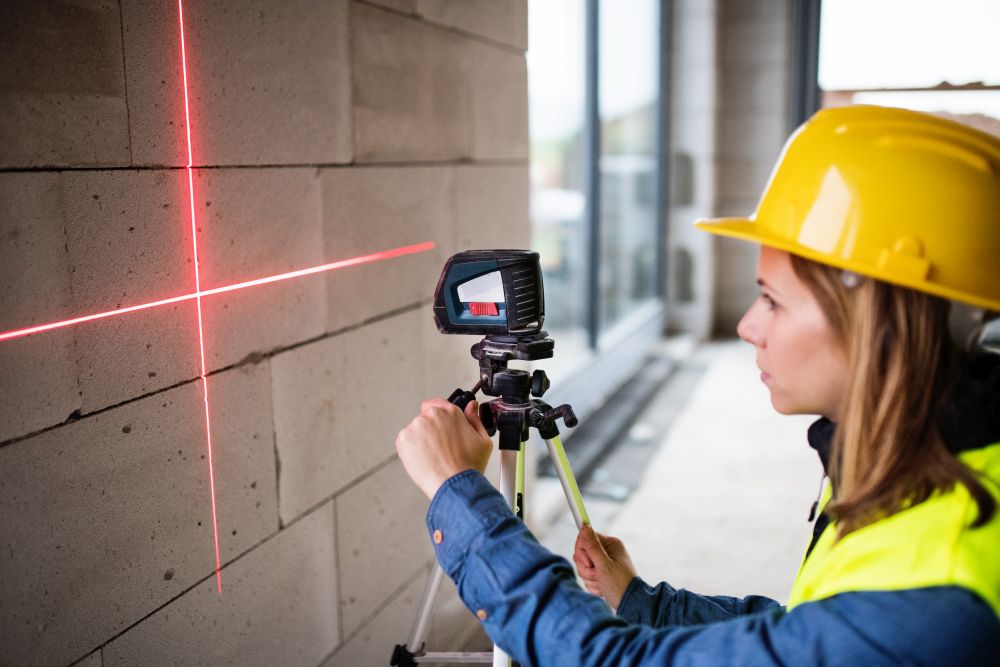
You’ve likely heard the expression “measure twice and cut once.” Efficient and accurate layout and design practices begin with proper measurements. The best way to ensure you only have to “cut once” is to employ laser scanners.
Commercial-grade laser measurement equipment has been around for years, but it’s more varied, reliable, and accessible today than ever. As this technology has evolved, its potential in layout and design has grown. It’s now increasingly clear that lasers will be the future of construction accuracy for a few reasons.
Higher Accuracy
The most straightforward advantage of lasers is their remarkable precision. Many commercial options are accurate within one-sixteenth of an inch. Beams are also unaffected by gravity, wind, and other external forces, so they maintain a straight line in all conditions.
While tape measures may be sufficiently accurate for basic dimensions, conventional means become less reliable in complex use cases. Calculating the area of a larger or unusually shaped space introduces more room for error with manual alternatives. Using lasers instead simplifies these calculations to improve reading accuracy, preventing future mistakes.
Ease of Use
It’s also worth considering how easy these tools are to use. Most of the laser measurement process is automated, minimizing the risks of human error. Mistakes are so common in this sector that rework accounts for up to 12.4% of total contract values, so preventing them can save considerable money.
Ease of use is particularly valuable amid ongoing labor challenges. As construction demand rises, many teams may rely on new, less experienced workers as they accelerate hiring to support growth. That lack of experience is less of an issue when tools don’t have a steep learning curve.
Faster Measurements
Lasers also streamline the layout and design process. Readings happen almost instantaneously since beams travel at the speed of light. As a result, you can specify more dimensions in less time without sacrificing the accuracy of your specs.
As with rework and error prevention, this benefit saves money in the long term. It’s also increasingly hard to ignore amid the persistent labor shortage. The construction industry needs another 501,000 workers to meet demand, but such gaps are less pressing when one contractor can complete more work in less time.
Improved Project Efficiency
Newer laser tools can connect to digital solutions like building information modeling (BIM) platforms to offer even greater benefits. By connecting this data to other technologies, you can drive higher efficiency and error reduction across the entire project.
Laser scanners can collect millions of data points in a single pass, providing BIM with a greater range of information to create more detailed models. That makes it easier to design spaces digitally without errors and to enable reliable clash detection features. The snowball effect of benefits leads to significant time and cost savings throughout the project.
Collecting so much data and transferring it to other digital platforms also streamlines communication. The workers performing the initial laser measurement can upload dimensions in seconds for those in future phases of the project to reference. That way, there’s no time-consuming back-and-forth and teams avoid miscommunication since everyone refers to the same, original measurement.
How to Use Lasers in Layout and Design
You can take advantage of these benefits in several ways. The simplest is to use hand-held laser scanners as a tape measure replacement when recording the dimensions of a space. Larger, multibeam tools can measure an area along multiple lines at once, providing a quick and accurate reading of a room’s square footage.
Laser projection tools can work as levels to give you a reliable point of reference when hanging items or ensuring even surfaces. This technology is better at these types of work than conventional alternatives because lasers do not sag with gravity or other external conditions.
You could also use lasers to find intersecting points between two lines when measuring where a pillar or other structure must go in a room. That way, you can start installation without fear of needing to tear anything down and start over. In addition to saving time, this reduces the waste that increases project expenses by up to 30% through management costs.
As you approach laser measurement, it’s worth taking the time to consider cost factors. While it’s true that many commercial tools are more expensive than conventional alternatives, they can actually save money in the long run. The resulting efficiency and error reduction reduce waste and other project costs, eventually making up for the initial price. You’ll get a better return on that investment when you use this equipment in a wider range of use cases.
Lasers Will Drive the Future of Construction
Regardless of the specific application, laser measurements have vast potential in layout and design accuracy. This technology is already readily available, so you don’t need to wait to start using it. Learning how to capitalize on its advantages today could help you develop a more efficient and reliable workflow tomorrow.
- Share This →